LE SIEGE DE CORINTHE | Rossini Opera Festival
A Clash of Eras: The Aesthetic Conflict of “Le siège de Corinthe”
“Le siège de Corinthe” (The Siege of Corinth) was the first opera Gioachino Rossini specifically composed for the Parisian stage. For this work, the composer partially adapted his beautiful and innovative Maometto II—originally written for the Teatro San Carlo in Naples in 1820—setting to music the theme of the fight for freedom, a cause that greatly inflamed public opinion and intellectuals like Lord Byron at the time. Recounting the dramatic events of Corinth besieged by the Turks in 1453, Rossini captured the revolutionary spirit shaking contemporary Greece, which was then tormented by its struggle for independence and the bloody siege of Missolonghi. (Notably, Rossini had organized a heartfelt and moving benefit concert for the fallen soldiers of Missolonghi on April 3, 1826).
The Neapolitan failure of Maometto II stemmed from musical innovations too bold for its time. These choices undermined the traditions of Italian opera seria by minimizing closed forms and introducing grandiose musical structures, such as the famous 25-minute “terzettone” in the first act. Also set during a Turkish siege in Greece—specifically Negroponte, now Chalcis on the island of Euboea—the opera depicted the internal conflict of the protagonist, Anna Erisso, who was torn between her romantic love for Maometto and her moral duty to her country and father. This led to a tragic and dramatic finale featuring the protagonist’s suicide, a scene considered far too powerful and dark for the tastes of the 1820 audience.
For the Paris stage, Rossini reworked Maometto II into the French grand opéra style, modifying its structure, characters, and, above all, the political undertones of the drama. To satisfy the demands of grand opéra, the composer added an imposing overture, solemn choral interventions, and the traditional second-act ballet. At the same time, the virtuosic Italian vocal writing—originally created for the astonishing voice of Isabella Colbran—was streamlined in favor of a more simplified, dramatic declamation better suited to the French language.
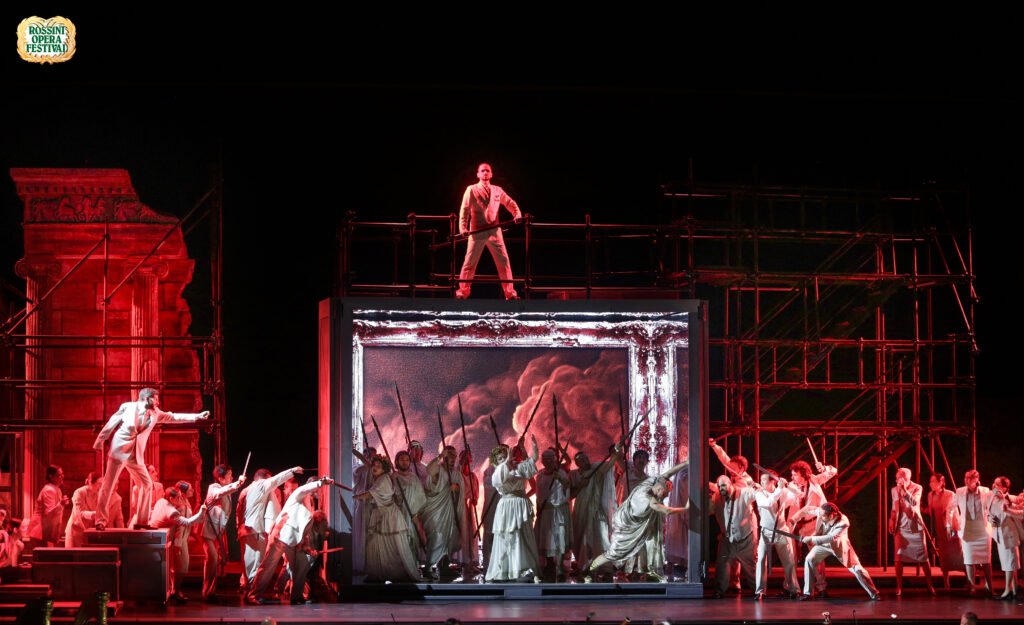
The Rossini Opera Festival, now in its 47th edition, is staging this grandiose and rarely performed opera for only the third time in its glorious history (following productions in 2000 and 2017). This staging utilizes the essential Critical Edition edited by Damien Colas Gallet, published in collaboration with Ricordi in Milan.
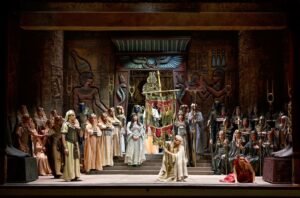
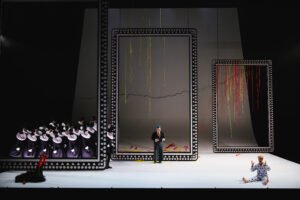
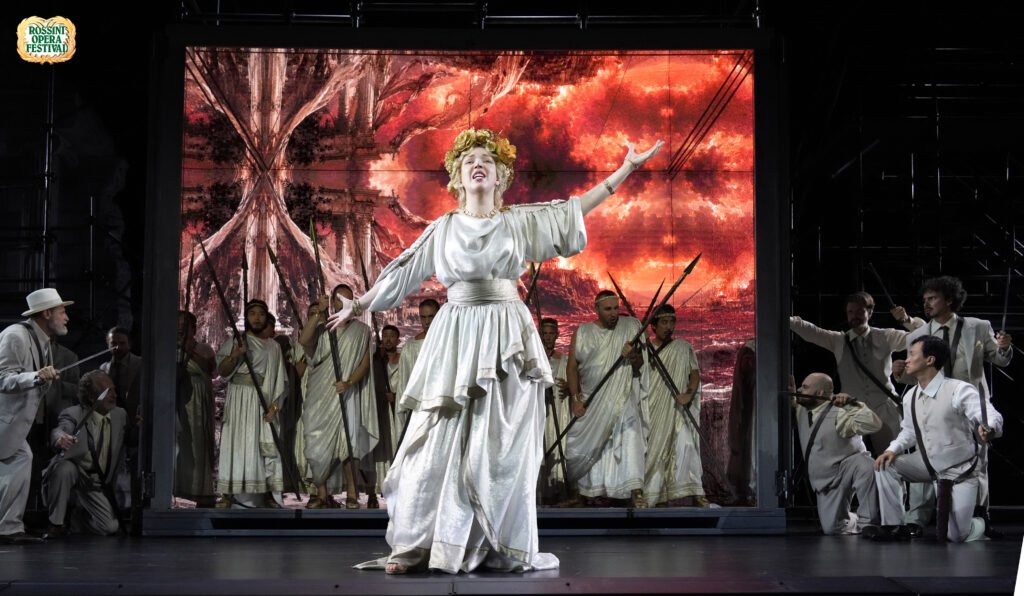
The visual production of this edition was entrusted to Davide Livermore and his team, who offer an interesting and ultimately successful reinterpretation. Instead of focusing on the historical Hellenic-Ottoman conflict, the director frames the work as a clash between the eternal beauty of classical art and the destructive force of contemporary modernity. This contrast pits the world of the Greeks (representing classical antiquity, dressed in traditional costumes, peplums, and togas) against that of the Turks (representing a consumerist and vulgar modernity, clad in contemporary attire and brandishing omnipresent cell phones). The production is set in the underground warehouses of a large museum—a concept very reminiscent, perhaps too much so, of Laurent Pelly’s famous staging of Julio Cesare. Large wooden crates contain statues and antiquities, and the largest set piece features inevitable video projections inspired by the works of the celebrated Greek painter Theodoros Vryzakis, a key artist of the Greek Revolution. In this staging, these images are vandalized with spray paint by Mahomet’s followers. Overall, Livermore’s show is highly effective and evocative, vividly contrasting the beauty of the past with the vulgarity of a present obsessed with self-celebration through selfies. Consistent with this directorial vision, the dance scenes, executed by eight dancers with choreography by Erika Rombaldoni, are remarkably elegant. Less successful, however, is the now-inevitable dramatization of the overture, which features Greeks dressed in white peplums rushing madly across the stage between the Venus de Milo and a statue by Canova. This chaotic staging felt completely disconnected from Rossini’s solemn and epic music.
Musical direction was entrusted to the expert baton of Carlo Rizzi, who confidently mastered the massive score and its proto-grand opéra style. Rizzi placed great emphasis on the crowd scenes and choral numbers, supporting the warlike nature of the libretto with robust sonorities and a sonic palette dominated by brass and percussion. The narrative pacing was tight and decisive, showing no weakness in the stretta. However, this dark and martial approach came at the expense of the opera’s more lyrical and intimate moments, sacrificing much of its Italianate warmth. The performance by the Orchestra del Teatro Comunale di Bologna was excellent, with noteworthy contributions from its instrumentalists during numerous solos. Principal clarinetist Simone Nicoletta deserves special mention for his cantabile, expressive tone, and masterful use of pianissimo. The Chorus of the Teatro Ventidio Basso was equally superb, delivering a beautifully solemn and captivating reading of “Divin prophète, entends nos voeux.”
The vocal cast was dominated by Vasilisa Berzhanskaya‘s Pamyra. The Russian singer had already performed a formidable Anna in Maometto II at the Teatro San Carlo in 2023, and in Pesaro she confirmed her status as a leading interpreter of this Rossini repertoire. Her vocal color, sitting beautifully between soprano and mezzo-soprano, her exceptional range—which moves effortlessly from a powerful low register to ringing high notes—and her technical mastery of virtuosic coloratura and agility make her a near-perfect interpreter of the “Colbran roles,” as well as those premiered by Laura Cinti-Damoreau, Rossini’s favorite French soprano. Her vocal performance in the second act was exceptional; here, Pamyra sings almost uninterruptedly, reprising music written in Maometto II for both Anna and Calbo (a contralto en travesti role). Berzhanskaya commanded the writing with a spectacular display of vocal and expressive power, executing perfectly nuanced coloratura and cadences that fearlessly reached the high D6. Her performance of the third-act prayer, “Juste ciel, ah! Ta clémence”—the opera’s most famous excerpt—was equally flawless.
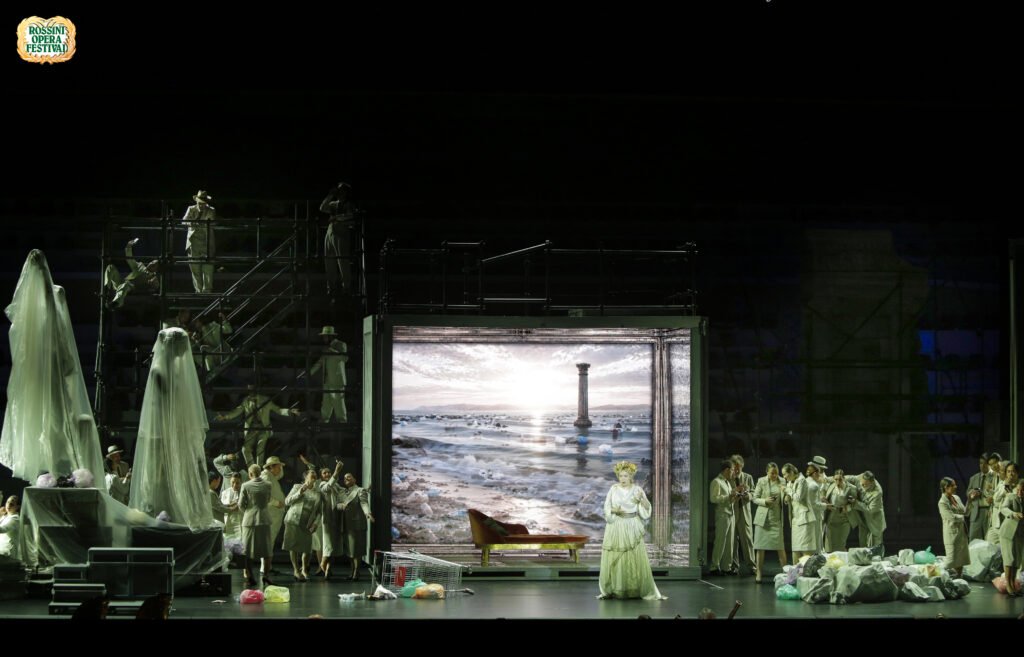
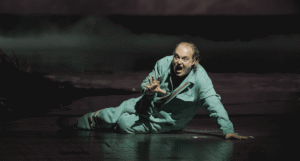
The rest of the cast maintained a generally solid level of precision. Adrian Sâmpetrean portrayed Mahomet II with a beautiful bass-baritone voice and a commanding stage presence. Although streamlined and simplified compared to the Italian original, the role remains among the most demanding bass parts written by Rossini. At times, Sâmpetrean lacked the necessary vocal charisma; while his coloratura was executed correctly, it was not as nuanced and precise as one might hope. Consequently, his performance of the cabaletta “Chef d’un peuple indomptable” lacked an imperious accent, and even the high F that closes the section lacked boldness.
Cléomène, Pamyra’s father, was sung by tenor Matteo Roma, who acquitted himself well in a noble and heroic role. He displayed good phrasing and excellent expressive intent, securely navigating the ascent to the high notes during the curse scene at the end of the first act.
Néoclès is the character who underwent the most radical transformation in the transition from the Italian opera (where it was sung by a contralto en travesti) to the French version, where it was premiered by the celebrated tenor Adolphe Nourrit. Maxim Mironov sang the role with a very clear timbre and effortless high notes, allowing him to master the formidable high tessitura. His major third-act aria, “Grand Dieu, faut-il qu’un peuple,” was beautifully resolved through noble, pathetic singing and great stylistic elegance.
In the role of the high priest Hiéros, bass Simón Orfila displayed impressive vocal volume and solid low notes, though he occasionally wavered on top. Nevertheless, his third-act prophecy proved to be highly impactful and authoritative, both dramatically and vocally.
The cast was rounded out by Tianxuefei Sun (whose French diction has room for improvement), Giuseppe De Luca(who brought a beautiful bass voice to the role of Omar), and Anna-Doris Capitelli, who used her burnished mezzo-soprano voice to beautifully deliver Ismène’s arioso, “L’hymen lui donne une couronne.”
The performance was a resounding success with the audience that packed the Scavolini Auditorium, earning enthusiastic applause for all performers and ovations for Vasilisa Berzhanskaya
CAST
Mahomet II ADRIAN SÂMPETREAN
Cléomène MATTEO ROMA
Pamyra VASILISA BERZHANSKAYA
Néoclès MAXIM MIRONOV
Hiéros SIMÓN ORFILA
Adraste TIANXUEFEI SUN
Omar GIUSEPPE DE LUCA
Ismène ANNA-DORIS CAPITELLI
Conductor CARLO RIZZI
Director DAVIDE LIVERMORE
Assistant Director SAX NICOSIA
Settings ELEONORA PERONETTI, PAOLO GEP CUCCO, DAVIDE LIVERMORE
Video design D-WOK
Costumes GIANLUCA FALASCHI
Choreography ERIKA ROMBALDONI
Lighting designer NICOLAS BOVEY
CORO DEL TEATRO VENTIDIO BASSO
Chorus Master PASQUALE VELENO
ORCHESTRA DEL TEATRO COMUNALE DI BOLOGNA
About the Author