LUCIA DI LAMMERMOOR | Deutsche Oper Berlin
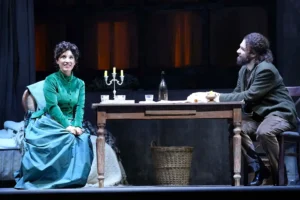
An opera whose success has never waned, Lucia di Lammermoor remains one of those experiences in which the spectator is, at least on paper, exposed to some of the most enchanting that bel canto has to offer. There is therefore good reason to open a new opera season with a work whose title role, a symbolic embodiment of femininity crushed to the point of madness by social phallocentrism, is more subtle than it might appear. Nina Minasyan’s delicacy and elegance of interpretation – despite a few vocal limitations – are there to demonstrate it. The story is certainly one of avowed Romanticism, with literary sources of inspiration to match and virtuosic vocal performances, but more than ever, the existence and power of the psychological violence to which the central character is subjected resonates today.
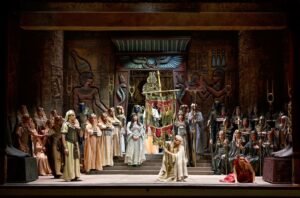
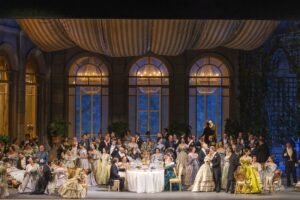
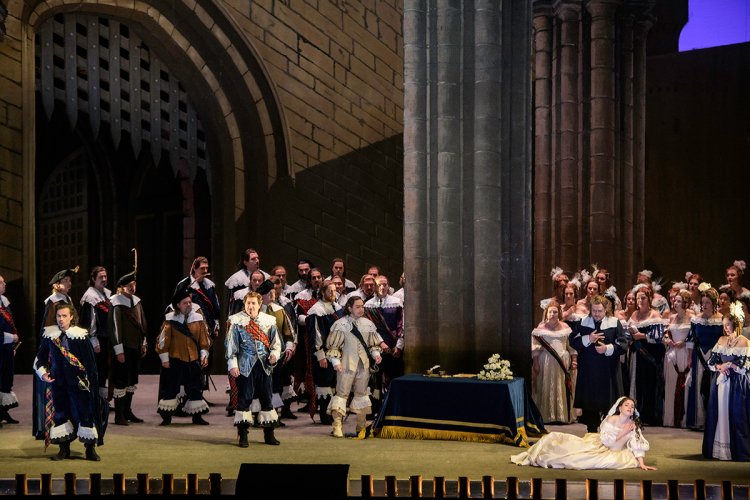
The production presented at the Deutsche Oper Berlin dates from 1980. Its new Intendant, Aviel Cahn (who has just arrived from the Grand Théâtre de Genève), had the opportunity to see it at a time when the Iron Curtain still ran through the divided city of Berlin, and retains a moving memory of it, which he shared with the audience shortly before the curtain rose on the performance of 5 September. Designed by Filippo Sanjust (1925–1992), it embodies the most classical approach: the action is set in the capa e espada Scotland of Salvadore Cammarano’s libretto, based on Walter Scott’s novel The Bride of Lammermoor. Here, Enrico exercises his power through brutality, including physical violence; Raimondo confines himself to his role as a priest, hands clasped and prayers on his lips; while Lucia, more helpless than ever and condemned by her surroundings from the outset, is gradually driven mad by violence that is first psychological and then physical. Even physically, she occupies a position of submission, being smaller than every other singer in the cast.
It is difficult to draw a parallel with the way Lucia might be interpreted today: more than ever, the production encourages an almost instantaneous reading of the character, confined to the framework in which the libretto places her. And it is refreshing to see an aesthetic that offers the audience an image ultimately quite faithful to the unfolding of the action, following an approach that is, if not identical, at least close to that imagined by the composer and his librettist. The sets and lighting likewise reinforce the sense of oppression, the icing on the cake being the Chor der Deutschen Oper Berlin, overwhelming in a performance of virile, powerful beauty, with a few glimpses of lightness during Lucia and Edgardo’s first-act meeting. For the miracle to happen, there is no need to reinvent the concept or turn everything upside down. Sometimes, the simplest approach can yield the best results, especially when the intention is to remain faithful to the ideas set out from the outset in the libretto.
This approach gives the soloists greater freedom of movement, less constrained by overly restrictive stage directions, and thus allows them to focus their attention on their voices. As the libretto of this dramma tragico is hardly among opera’s most accomplished – with psychological developments that are sometimes too rapid, polarised characters, and little room for nuance in the intentions – it is the vocal performances and refined orchestral support that audiences hope for once they take their seats. On the evening of 5 September, marked by a young but highly talented cast, we were not disappointed, although a few qualifications need to be made to this largely positive assessment.
Michele Spotti’s conducting combines the dynamism and enthusiasm, almost the sense of flight, required to hold the audience’s attention. Effects come thick and fast, orchestral colours shine, transitions from arias to recitatives are handled naturally, yet at a sustained pace. The narrative coherence remains intact, anticipating the tragic end of the story, and the balance between pit and stage is never compromised. Any lack of brilliance that may have affected certain performances – Nina Minasyan’ in particular – is largely offset by a conductor who shines and knows how to bring out the best in the soloists’ voices.
This is particularly true of Galeano Salas as Edgardo, in a role debut greeted with an ovation for the sheer power of his voice, inexhaustible from beginning to end, a living flame of the emotions that carry him through every situation presented in the opera. The richness of colour in his vocal palette is remarkable, as is the suitability of his instrument to the repertoire he performs. At times, however, we had the impression that the synergy between Edgardo and Lucia was not quite fully established: despite interesting vocal performances, were the singers truly listening to one another?
As for the title role, historical accounts tell us that Donizetti composed Lucia for Fanny Persiani, a lyric-leaning coloratura soprano with an exceptional upper extension. The character was very soon classified as coloratura, turning the category into a synonym for a light soprano and overlooking the fact that it refers simply to agility. In reality, Lucia has a range that is certainly quite high, but requires a well-developed lower middle register. Indeed, from her opening recitative and cavatina onwards, this lower middle register is exposed in highly expressive falls at the ends of phrases. It is in these moments that Nina Minasyan demonstrates a finesse of execution that is entirely appreciable, even moving, seeking – and succeeding – in conveying a fragility of character, a melancholic depth and a sensitivity on a knife-edge that foreshadow the story’s denouement. Her Lucia is devoid of any capacity for action: every attempt to counter her brother’s designs is doomed to failure and, from the outset, there is only one possible outcome: imposed consent. Yet in the mad scene of Act III – the only way for her to free herself from the masculine yoke that crushes her, to find an escape from a world that reduces her to a decorative figure -, the performance remains restrained. Her emission sits lower than that of other interpreters, her projection is suited to the hall but does not astonish, the coloratura is delivered mechanically, and it is possible that a certain degree of nervousness explains the difficulty in embodying the intensity the moment demands. The brilliance of the bel canto aesthetic is therefore somewhat dimmed, although overall the performance remains sound. If this is a deliberate choice, one possible explanation for a less dazzling mad scene would be the exhaustion of the character’s energy as she reaches the very end: having been reduced to a role that does not suit her, in which her vital energy is gradually consumed, even the eruption of madness is muted. This Lucia, a kind of martyr to men’s thirst, lacks even the energy to die.
The male voices bring unexpected and thoroughly positive surprises to the evening. Mattia Olivieri, without lapsing into morbidezza, makes Enrico more human and less Machiavellian, while retaining that lack of moral integrity which makes the character one of the most reprehensible in the repertoire. His voice is noble, his phrasing elegant, and the audience makes its enthusiasm known. Omar Mancini (Arturo) gives an energetic performance, and it is almost a shame to see him in a role in which we can only glimpse the full range of a singer whose commitment is admirable, rising above the chorus with a highly distinctive character tenor voice. Likewise, Nicolai Elsberg’s (Raimondo) commanding voice, with its almost cavernous timbre yet solid projection, reveals enormous potential for the great bass roles – and not only in the Italian repertoire. What surprises might his instrument have in store once he gets his hands on the great characters of Mussorgsky?
Ultimately, it is therefore a strong male cast that gives us the evening’s most admirable moments, demonstrating that this opera is not confined solely to the feats of the female voice. The execution of the title role may be revealing of a vision of Lucia di Lammermoor more than 40 years old, yet it continues to enchant the audience – as the ovation at the end proved beyond doubt.
******************************
LUCIA DI LAMMERMOOR
Dramma tragico in drei Akten von Gaetano Donizetti
Libretto von Salvadore Cammarano nach dem Roman The Bride of Lammermoor von Walter Scott
Uraufführung am 26. September 1835 in Neapel
Première an der Deutschen Oper Berlin am 15. Dezember 1980
Musikalische Leitung | Michele Spotti · Regie, Bühnenbild und Kostüme | Filippo Sanjust · Choreinstudierung | Marco Medved
Lord Enrico Ashton | Mattia Olivieri · Miss Lucia Ashton | Nina Minasyan · Sir Edgardo di Ravenswood | Galeano Salas · Lord Arturo Bucklaw | Omar Mancini · Raimondo Bidebent | Nicolai Elsberg · Alisa | Marlen Bieber · Normanno | Michael J. Scott · Chor der Deutschen Oper Berlin · Orchester der Deutschen Oper Berlin · Cover photo credit: ©Bettina Stöß
(For further informations) Link to the Deutsche Oper Berlin: Lucia di Lammermoor
About the Author