LULU | Staatstheater Nürnberg
My first memory of Lulu is not operatic but pop-musical. Born into a household where British pop was in full swing, my point of reference was Pandora’s Box by Orchestral Manoeuvres in the Dark, released in 1991. For those unfamiliar with it, the song traces the life of Louise Brooks (1906-1985), the celebrated American silent-film actress of the interwar period who became famous for the title role in G. W. Pabst’s 1929 film. Nearly a century after the film’s release, she remains, for a wide audience, the embodiment of the original Lulu: the heroine of Franz Wedekind’s plays Erdgeist (1895) and Die Büchse der Pandora (1902). As for Berg, I came to him much later, first through Wozzeck and then through this work, far removed from the carefree exuberance of the British band. For less experienced ears and eyes, listening to or watching this opera may not be an entirely comfortable experience. The subject matter is as provocative as a Verhoeven film, and the music is no less unsettling. The orchestral richness is immense, matching the complexity of the emotions and situations it portrays.
It is therefore with almost childlike anticipation that one travels to the city where Wedekind’s Die Büchse der Pandora was first performed, at the Intimes Theater on 1 February 1904, in a private performance – the only means of circumventing particularly virulent censorship – for the performance of 30 May.
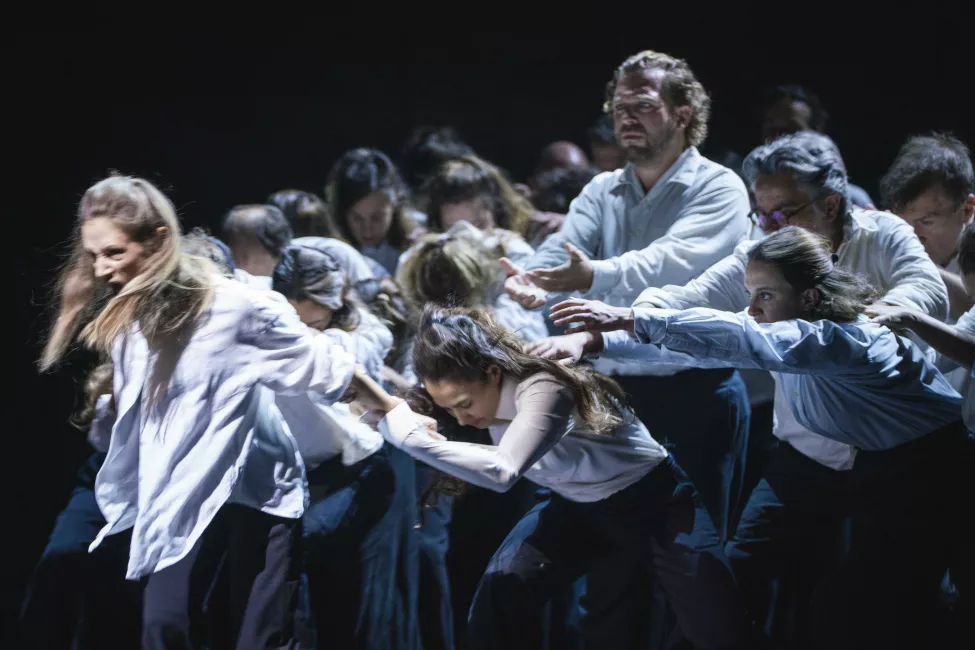
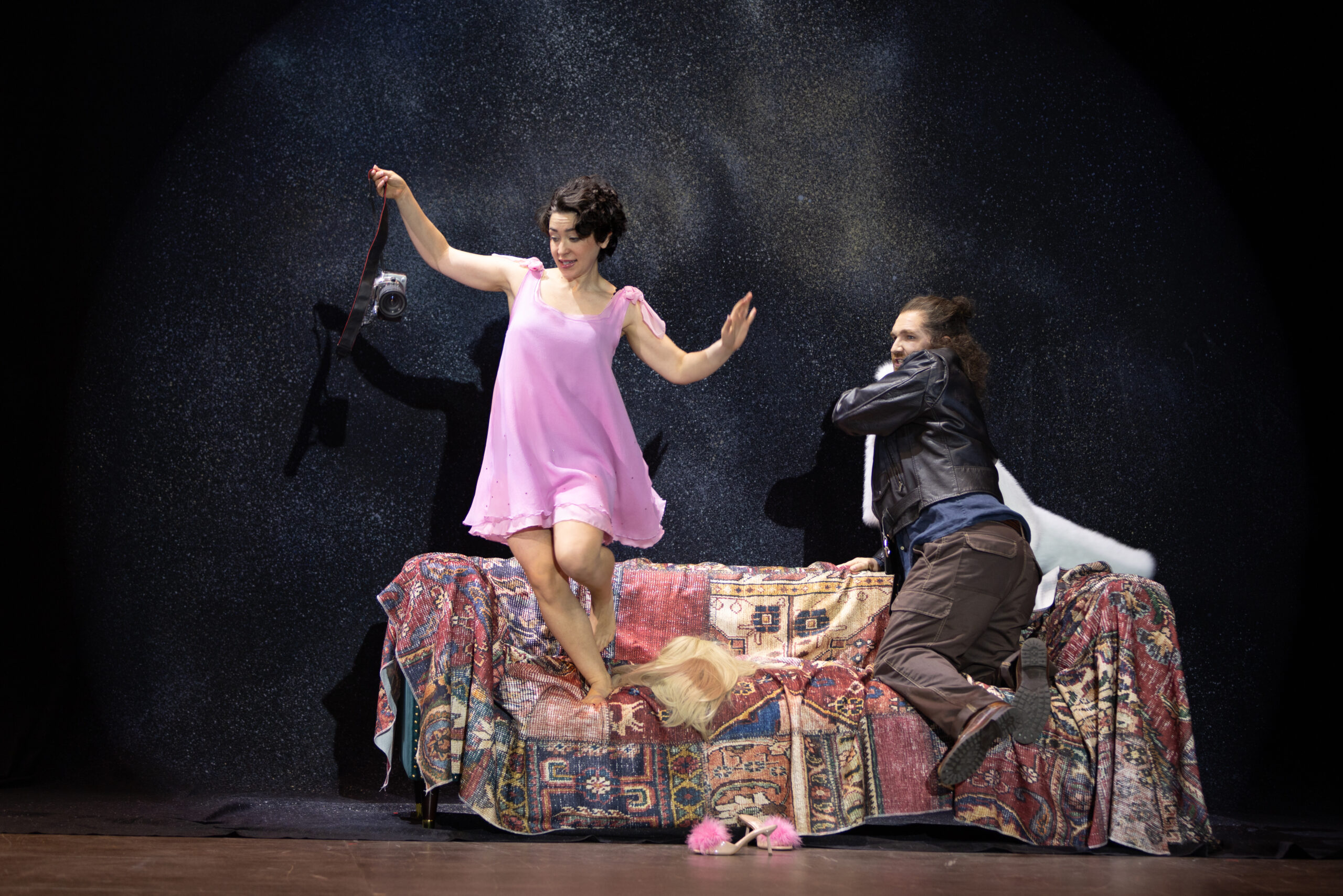
Jens-Daniel Herzog’s reading neither captivates the eye nor particularly stimulates curiosity. The character designs are based on the broad outlines of the script, without, however, offering a proposal that, at first glance, seems better suited to the story it sets out to recount. The action is updated to the present day: the painter becomes a photographer, while letters are replaced by text messages. From the moment the curtain rises, we are confronted with a Lulu on the verge of madness, whose downfall appears less moral than psychological. The relative hardness of Schön’s character and the morbid nature of Jack the Ripper are preserved, as are the principal traits of the other characters (with the exception of Geschwitz, who appears somewhat too withdrawn and passive considering the crucial role she plays from her very first entrance). Yet some of the situations depicted lack either theatrical imagination or plausibility (would one really expect to find a latrine in a photographer’s studio?). Nevertheless, the well-paced acting is commendable, as is the effort made to showcase the sets throughout the scene changes.
If the staging leaves no indelible mark, the voices most certainly do.
Beginning with the title role, magnificently defended by Juliana Zara. Dramatic projection is there, lyricism is there, intensity is there, and never falters. At times a living flame, at others a blazing pyre, at once a translucent screen for every fantasy projected upon this most paradoxical of Lulu, she makes the role entirely her own. Its formidable challenges (wide intervallic leaps, angular syllabic writing, syncopations and sheer endurance) are mastered with consummate skill. Even in the midst of catastrophe, the voice remains luminous, youthful and incisive, confirming her position as the opera’s dramatic centre of gravity. She cuts through an orchestra that is at times unleashed with the force that only Lulu’s irrepressible transgression can command, and occasionally pushes beyond what seems possible, as in the high D that some consider unattainable in the Lied der Lulu in Act II. Like Elektra, Lulu is a role that is almost impossible to cast. Truly convincing interpreters can be counted on the fingers of one hand. Juliana Zara is the first name that comes to mind.
On the opposite side of the chessboard stands Simon Neal as Dr. Schön and Jack the Ripper. To describe him as heroic or dramatic hardly does justice to a voice whose middle register is every bit as solid as its upper reaches. In his confrontations with Juliana Zara, one genuinely wonders which of the two will emerge victorious. Hearing him alongside the Californian soprano is a particular pleasure, for their contrasting styles ultimately prove complementary. There is nobility of line, certainly, but also a metallic hardness and authority that do not prevent the character from meeting an end poised somewhere between murder and suicide.
Need a moment of respite between the two poles of energy and power represented by Lulu and Schön? It is provided by the radiance of Martin Platz’s Alwa. With great dexterity, he shapes the long lyrical lines through which the character comes fully to life, overcoming the rhythmic complexity with apparent ease while preserving the clarity of a voice capable of conveying both tenderness and despair. He proves the ideal witness to, and victim of, Lulu.
Through an emotional intensity that fully conveys the opera’s tragic burden, Almerija Delic offers a luxury-cast Gräfin Geschwitz. The timbre is dark yet velvety, perfectly capturing both the ardour of the opening scenes and the mortal anguish of the end. This selfless, almost martyr-like love is portrayed with admirable restraint, avoiding pathos and reinforcing the sacrificial dimension of the character’s devotion to the object of her obsession.
Taras Konoshchenko’s Schigolch would perhaps gain in credibility if his cantante bass timbre, somewhat removed from the worn and rasping sound that the character’s psychology seems to demand, conveyed more cynicism in his cowardice and ambiguity towards Lulu. His performance remains perhaps a little too noble for what the role requires. Unpleasant? Far from it. Yet one struggles to discern the mixture of pimp and parasite that makes the character so profoundly unpalatable. That baseness of intention, that absence of scruple, that sardonic coldness, are present in abundance in Georg Festl’s outstanding portrayal of der Tierbändiger and der Athlet. With his broad, dark timbre – a potent blend of menace and sarcasm – he becomes the perfect embodiment of both physical and (a)moral violence. A chiselled, cutting voice, standing at the opposite extreme from Alwa, he contributes once again to the balance of a vocal tapestry so skilfully sustained by the soloists. Tristan Blanchet’s warm, vibrant tone brings the fragile sensitivity required for the Maler, as well as the touch of exoticism needed for the Freier. Hans Kittelmann, an agile character tenor with a finely honed sense of comic style, delivers convincing portrayals of the Prinz, the Kammerdiener and the Marquis.
Roland Kluttig offers not merely an orchestral reading but an almost visual realisation of the score, one of the rare works that allows a conductor to construct such serially organised momentum that one has the distinct impression of listening to a film. This polyphonic writing, whose colouring recalls Mahler, is rendered with all the clarity its naturally formidable density permits. Tempi are broadened in order to support the singers more effectively; transitions remain taut, while tension and violence are dispensed with consummate skill before erupting at crucial moments. Refined strings that never saturate the texture, incisive woodwinds and threatening brass combine to create an experience that at times evokes the very finest achievements of Weimar cinema.
Before I came here, it was the faces of Teresa Stratas, Christine Schafer, Marlis Petersen, Anneliese Rothenberger and, invariably, Louise Brookes, that brought to mind this character who defied taboos, rules and conventions. Now Juliana Zara joins this line-up, bolstered by fond memories of that magnificent performance in Nuremberg.
******************************
LULU
Oper von Alban Berg
Libretto von Alban Berg nach Erdgeist und Die Büchse der Pandora von Frank Wedekind
Neufassung des 3. Akts von Eberhard Kloke
Musikalische Leitung | Roland Kluttig · Regie | Jens-Daniel Herzog · Bühne | Mathis Neidhardt · Kostüme | Sibylle Gädeke · Licht | Fabio Antoci · Dramaturgie | Georg Holzer und Hans-Peter Frings
Juliana Zara | Lulu · Almerija Delic | Gräfin Geschwitz · Corinna Scheurle | eine Theatergarderobiere, ein Gymnasiast, ein Groom · Gor Harutyunyan | der Medizinalrat, der Professor · Tristan Blanchet | der Maler, der Freier · Simon Neal | Dr. Schön, Jack · Martin Platz | Alwa · Georg Festl | ein Tierbändiger, Rodrigo · Taras Konoshchenko | Schigolch · Hans Kittelmann | der Prinz, ein Kammerdiener, der Marquis · Wonyong Kang | der Theaterdirektor, der Bankier · Clarissa Maria Undritz | eine Fünfzehnjährige · Anna Bychkova | ihre Mutter · Laura Hilden | eine Kunstgewerblerin · Hektor Palmer Nordfors | ein Journalist · Qinchuan Lan | ein Diener · Staatsphilharmonie Nürnberg · Credit for the cover photo: ©Staatstheater Nürnberg/Pedro Malinowski
(For further informations) Link to the Staatstheater Nürnberg: Staatstheater Nürnberg
About the Author