TANNHÄUSER | Opernhaus Zürich
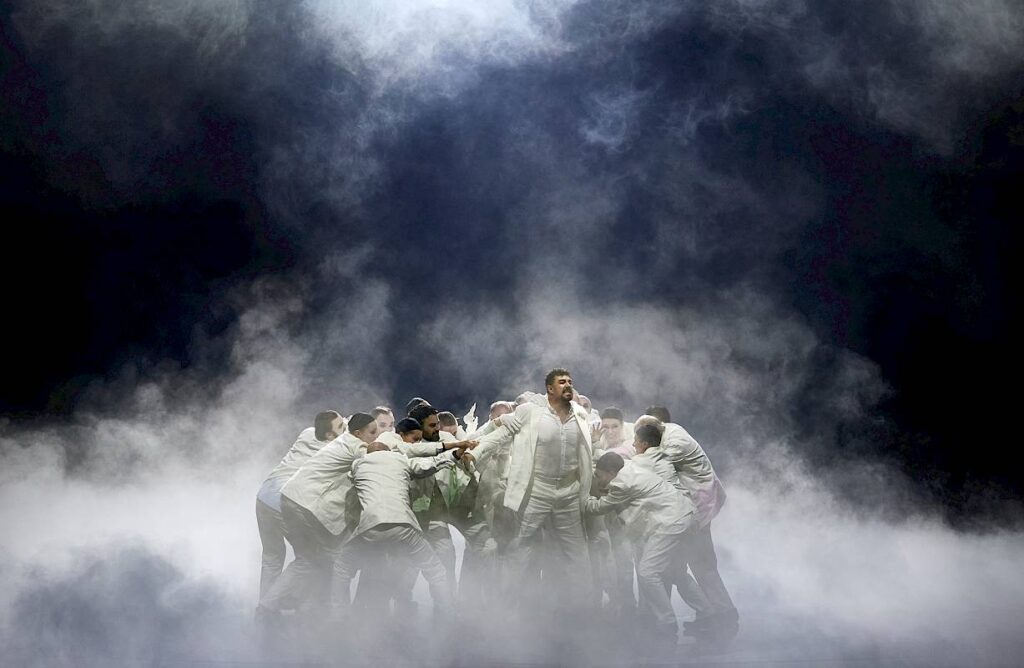
All photographies by Herwig Prammer
When Wonder Matters More Than Understanding: Tannhäuser, A Dreamlike Journey Between Desire and Redemption
Do we really need to understand everything we see in order to be moved by it?
That question stayed with me after Wagner’s Tannhäuser at Opernhaus Zürich. Thorleifur Örn Arnarsson’s production offered a succession of strange and beautiful images, some immediately affecting and others more elusive. They seemed to exist according to their own logic, appearing, transforming and disappearing like fragments of a dream.
Not everything asked to be explained. Much of it simply invited us to look, listen and wonder.
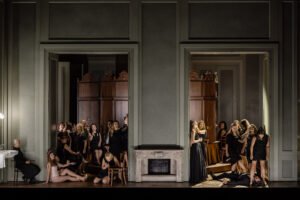
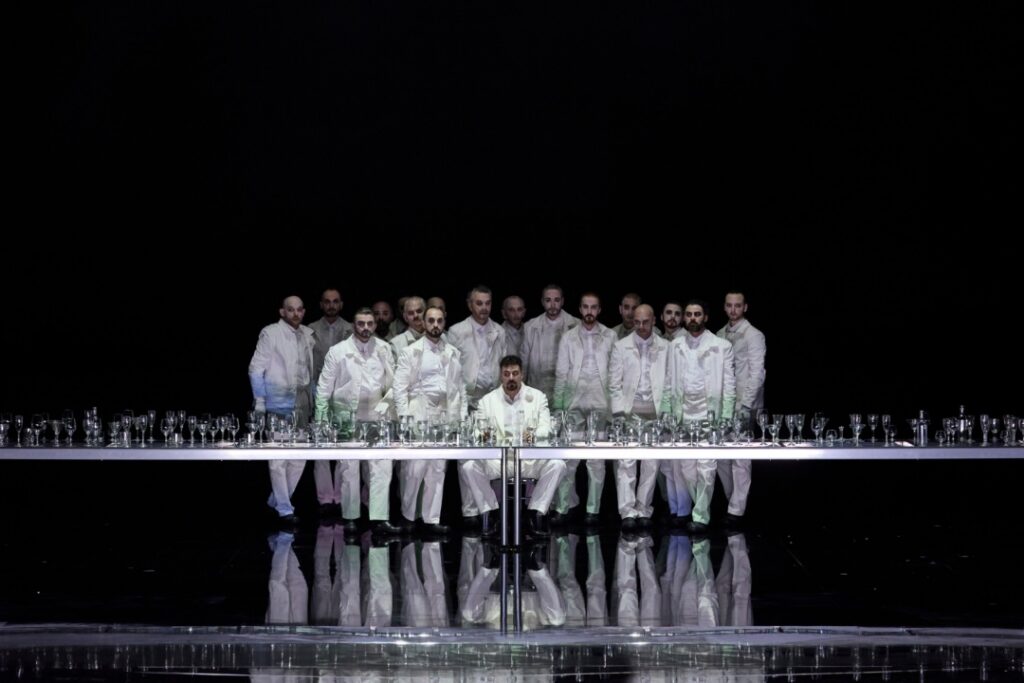
From its opening moments, the production created a world suspended somewhere between reality and imagination. Its dark backdrop, drifting clouds and slowly moving figures established an atmosphere that was at once elegant, distant and slightly unsettling. At its centre stood a magnificent rotating table covered with crystal glasses, reflecting the light as it turned.
It was an image of extraordinary beauty, but also one of fragility. Nothing in this world appeared entirely stable. The production could shift without warning from refinement to excess, from celebration to unease. Moments that initially seemed disconnected gradually began to feel like part of the same dream: unpredictable, sometimes bewildering, yet emotionally coherent.
Arnarsson never insists on a single interpretation. His images are allowed to breathe, leaving each audience member free to respond in their own way. That openness became one of the production’s greatest strengths. Instead of guiding us towards a single conclusion, it created an atmosphere in which desire, faith, guilt and hope could coexist without being neatly separated.
This felt especially appropriate for Tannhäuser, where every path towards fulfilment seems to lead to another form of loss.
Its protagonist longs for opposing worlds. He wants freedom and forgiveness, sensual fulfilment and spiritual peace. He turns away from one life only to discover that he cannot fully belong to the other. Even when redemption appears possible, he remains trapped by his own desires and by the judgement of those around him.
Eric Cutler’s Tannhäuser was a performance that grew steadily in emotional impact throughout the evening. His portrayal revealed a man torn between desire and redemption, unable to belong fully to either world. As the drama unfolded, Cutler brought increasing weight to the character’s isolation and inner turmoil.
His narration of Tannhäuser’s return from Rome was particularly affecting. By then, the character’s defiance had given way to exhaustion, and Cutler conveyed the sense of a man for whom hope had become almost impossible. It was a deeply committed portrayal, both vocally and dramatically.
Rachael Wilson brought a very different energy to Venus. Passionate, commanding and completely at ease in Arnarsson’s theatrical world, she gave the character an authority that extended far beyond simple temptation. Her Venus represented an entire realm of experience, one whose attraction Tannhäuser could reject but never entirely forget.
Yet although the opera bears Tannhäuser’s name, the emotional heart of the evening belonged, for me, to Elisabeth.
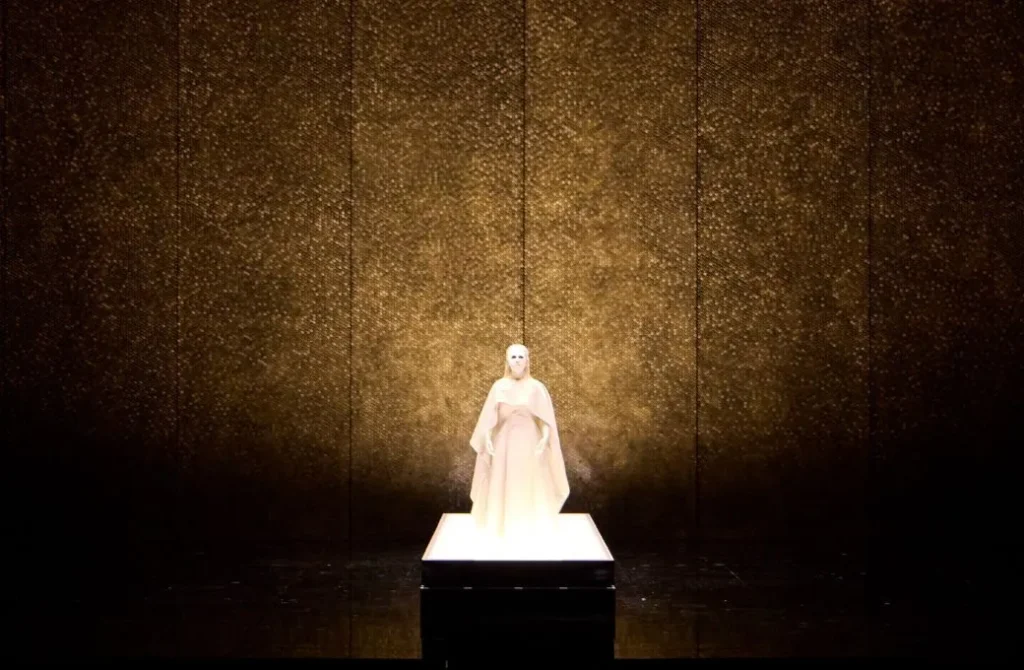
Arnarsson introduces Elisabeth through one of the production’s most striking visual ideas. She appears less like an ordinary woman than an immaculate figure, almost a marble Madonna placed beyond human reach. What follows is a quiet transformation, handled with remarkable simplicity, that gradually reveals Elisabeth’s humanity. It became one of the emotional threads that stayed with me throughout the evening, and one whose final destination I would rather leave for future audiences to discover.
Christina Nilsson was magnificent.
Having previously admired her in Gurre-Lieder at the Lucerne Festival, I arrived with high expectations. She exceeded them. Her voice combined radiance, precision and considerable power while retaining the warmth and delicacy the role demands. She could fill the house effortlessly, yet some of her most affecting moments came through restraint rather than sheer volume.
Most importantly, Nilsson never allowed Elisabeth to become merely an ideal. Beneath the production’s striking visual language, she remained profoundly human, a woman capable of love, hope and heartbreak. That emotional honesty made her final appearances almost unbearably moving.
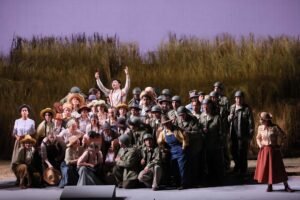
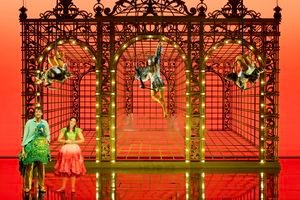
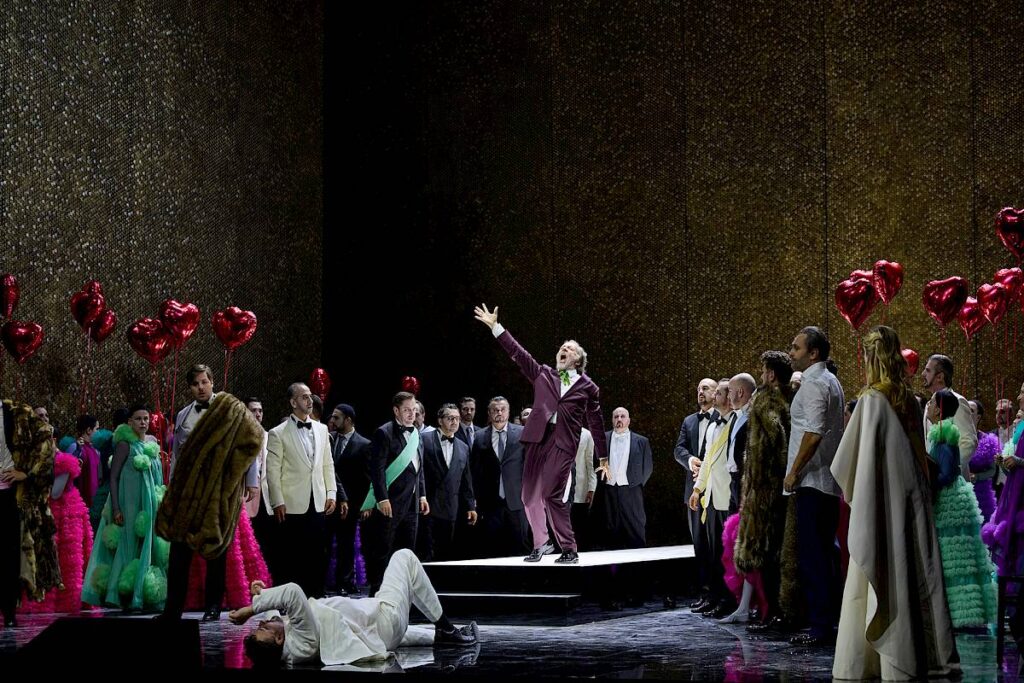
Around her, the production’s visual world continued to evolve. Monochrome austerity gradually gave way to unexpected colour and theatrical exuberance before shifting once again. Images that initially inspired wonder quietly acquired new emotional resonance as the evening unfolded.
It is here that the dreamlike nature of the staging proves most effective. Dreams do not proceed through careful transitions. One environment dissolves into another; an object that once appeared beautiful can later become threatening or sad. Arnarsson’s production follows that emotional rather than literal logic.
Under Tugan Sokhiev, the Orchestra of the Zürich Opera House delivered a performance of tremendous richness, sweep and dramatic intensity. From the opening bars, Wagner’s score created the world through which the staging could move so freely. Sokhiev shaped the opera’s vast musical architecture with remarkable patience, allowing its long arcs to unfold naturally without ever losing momentum. The orchestra responded magnificently, combining moments of luminous delicacy with immense orchestral power. Yet grandeur was never an end in itself. Beneath the scale of the score, there was always movement, tension and, above all, a deeply human sense of drama.
I do not feel the need to analyse Wagner’s recurring motifs technically. Their effect in the theatre was enough. Melodies returned carrying the memory of everything that had happened since we first heard them. What initially sounded like promise could later suggest longing, distance or loss.
That accumulation of emotion is one of Wagner’s extraordinary powers. The music remembers, even when the characters would prefer to forget.
I remember sitting completely still. By then, the music had taken over, and I simply let it.
Christian Gerhaher offered another of the performance’s unforgettable moments as Wolfram. His singing of O du, mein holder Abendstern seemed to suspend time. There was no need for exaggerated gesture or overt displays of emotion. Gerhaher’s extraordinary control, attention to language and ability to sustain a phrase allowed the aria to unfold with complete naturalness.
It was breathtaking precisely because it felt so unforced.
His Wolfram also provided an essential stillness within the production. Surrounded by Tannhäuser’s restlessness and the staging’s changing images, Gerhaher created a figure whose feelings remained largely contained. The tenderness of the Evening Star song therefore carried everything he had left unsaid.
The supporting cast contributed to an ensemble of remarkable consistency, while the production team sustained its distinctive visual atmosphere across an opera of considerable length. Despite the work’s scale, the evening never felt static. Music, performance and staging continued to reveal new shades of the central conflict.
By the end, what stayed with me was not a particular interpretation of every image, but the cumulative experience of the evening.
This Tannhäuser moved between beauty and discomfort, intimacy and spectacle, the sacred and the sensual. It trusted the audience to find its own way through those contrasts. Some viewers may see clear symbols where others perceive only impressions. Some may be unsettled by its sudden shifts; others may find themselves surrendering completely to its dreamlike rhythm.
For me, the production’s power came from the freedom it offered. It reminded me that opera does not always need to lead us towards certainty. Sometimes its images can remain open, continuing to change in our memories after the performance has ended.
I would gladly return to Arnarsson’s strange and beautiful theatrical world. A second visit would almost certainly reveal different details and stir different emotions. The autumn revival will retain Eric Cutler, Christina Nilsson and Rachael Wilson in the principal roles, while Markus Poschner takes over the musical direction and Andrè Schuen appears as Wolfram—changes that may bring new colours to the production.
But the strongest reason to return is simpler. It is the possibility of experiencing once again an evening in which music, theatre and performance created something larger than explanation. An evening that reminded me why opera can remain so compelling even after centuries of interpretation.
Not because it always gives us answers. But because, every so often, it leaves us with something even more valuable:
Wonder.
Cast & Creatives
Conductor — Tugan Sokhiev
Director — Thorleifur Örn Arnarsson
Set Designer — Erna Mist
Costume Designer — Teresa Vergho
Lighting Designer — Martin Gebhardt
Chorus Master — Klaas-Jan de Groot
Dramaturgy — Jana Beckmann, Roman Reeger
–
Hermann, Landgrave of Thuringia — Christof Fischesser
Tannhäuser — Eric Cutler
Elisabeth — Christina Nilsson
Venus — Rachael Wilson
Wolfram von Eschenbach — Christian Gerhaher
Biterolf — Andrew Moore
Walther von der Vogelweide — Johan Krogius
Heinrich der Schreiber — Nathan Haller
Reinmar von Zweter — Brent Michael Smith
A Young Shepherd — Yewon Han
About the Author