SAINT FRANCOIS D’ASSISE | Salzburger Festspiele
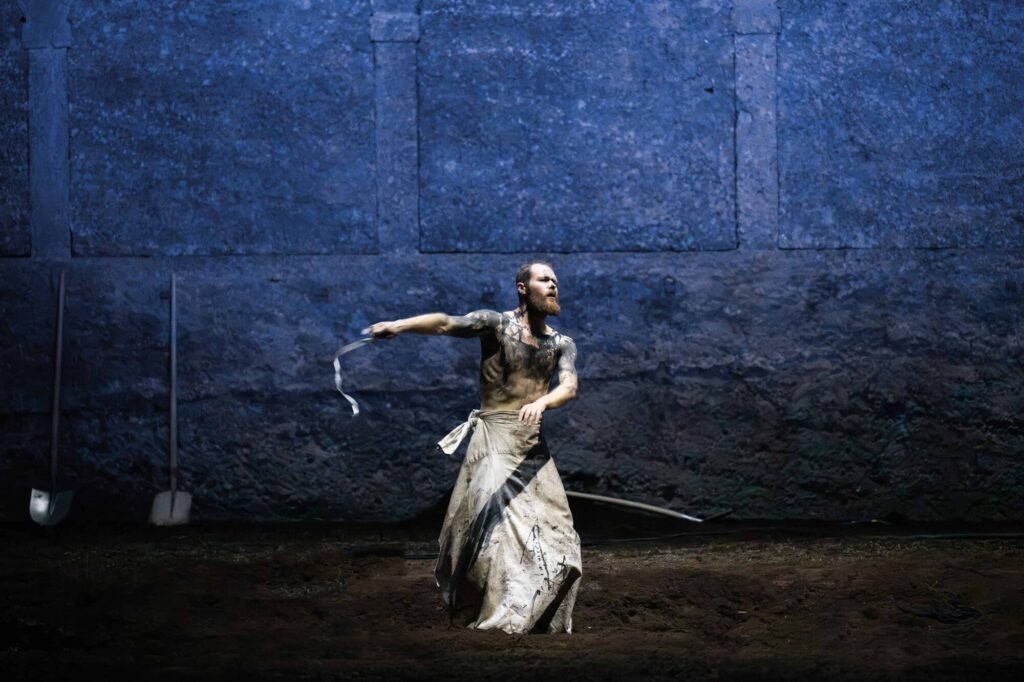
It was never meant to be taken as a traditional opera – Olivier Messiaen himself said so back in 1983. No passion, no crime, no murder. No vocal ensembles, no arias, no Leitmotive. At most, one can make out a few themes and, above all, birdsong, each linked to a particular character: the blackcap, for instance, inseparably tied to the saint of Assisi. Even so, three acts and eight tableaux were enough for Maxime Pascal and Romeo Castellucci to create a singular event, warmly received by critics and audiences alike at the 2026 Salzburg Festival.
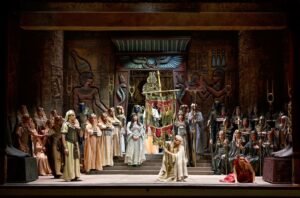
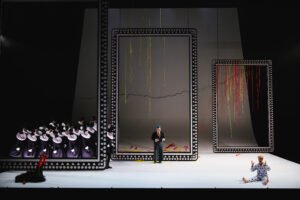
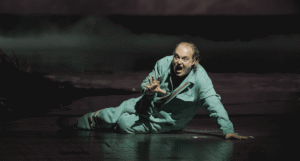
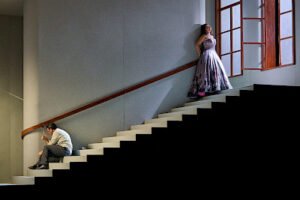
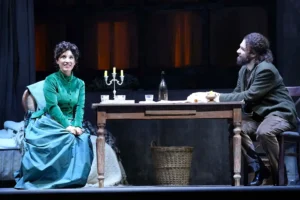
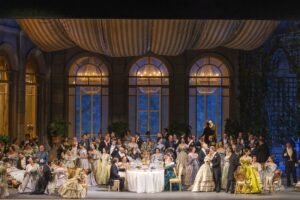
Across nearly six hours and twenty minutes, the audience (the Felsenreitschule filled to capacity for all six performances this year) is immersed in a world where sonic and visual environments rise from the earth. There is no provocation, yet no attempt to make the work more digestible either (Messiaen’s music remains an experience that demands not only sensitivity to his language but also preparation to appreciate it fully). Organic is perhaps the most fitting word, if one had to choose only one, for the experience. Castellucci had already stated his intention: his François is a man of extreme radicality, especially in a world where human action is destroying the natural heritage he holds dear. And this is shown without concession: violence (that which François inflicts upon himself, that which the Franciscans impose on him in the final act, the fall of dead birds onto the stage at the end of Act II), hallucinations, and finally death, in utter bareness – a naked body left against the stage wall. Sonically, it is a cathedral built from an “organised disorder”, exactly as Messiaen conceived it: delivered with almost surgical clarity, an intensity that grips the throat, and a complete absence of effect-seeking. Limpid, almost lapidary, yet never monolithic; on the contrary, air has never mattered more in a reading of this score.
Air… but also water, restoring strength, washing away at the start of Act I the François of before, so that the François of after may emerge once he chooses a new path. One of the superb black-and-white photographs displayed at the back of the stage announces it: a path of dryness, pain, and austere beauty lies ahead. And earth and fire in Act III, during the stigmata: the individual returning to the most elemental state before reaching a new dimension, becoming humus as necessarily as he has lived the entire journey until now; and the inner fire consuming him in an ultimate gesture of radicality, before he becomes, in his flesh, one of the representations of the One he sought to imitate throughout his life.
The François we see is human, profoundly human, all too human, and unsurprisingly, the path to sainthood is one of humanity pushed to its furthest limits. Philippe Sly, with an almost messianic presence on stage, makes the title role entirely his own, body and soul, with total theatrical commitment, while preserving a noble, velvety timbre and an unshakeable, almost ascetic vocal line, despite the phenomenal physical demands of the staging. At no point does the production suggest a sanctity adorned with caricature, implying any kind of perfection. In Castellucci’s vision, sanctity is forged in the most human expression of human reactions. Thus the scene of the Lépreux (sung by Sean Panikkar, with unmatched power and French articulation worthy of the finest francophiles), where François’s revulsion borders on terrified madness at the sight of this middle-aged man (Georg Schwamberger), skeletal, wearing a soiled nappy, whose dignity is restored, gesture by gesture, by a François who confronts his own finitude before a giant mirror. The same applies to François’s trance during the great concert of birds in Act II, already foreshadowed in Act I by one of the photographs displayed at the back of the stage, taken by Bruno Mooser in 1956, showing a young boy listening to music for the first time through an audiometer.
It is no exaggeration to say that there will be a before and after in the musical direction of Saint François following Maxime Pascal’s interpretation, leading a Wiener Philharmoniker of sumptuous naturalism and virtuosity. It is entirely fair to say this comes as no surprise, for who else but Pascal could offer a vision so personal and so true to the work? Absolute clarity, despite colossal orchestral density, creating spaces in which a breathtaking and bewitching chromatic diffraction can burst forth. No pathos, no drama – exactly as Messiaen requested. In close alignment with the staging, one is almost tempted to say that we hear François, scènes franciscaines rather than Saint François in the strict sense, and this is the logic of the interpretation: if the aim is to show the audience the path travelled by the man towards sainthood, then it is the Saint in becoming who must be revealed. Such is the wager, and such is the result. Less liturgy, more humanity.
The rest of the cast is as striking as the orchestral direction. Lauranne Oliva shines as the Ange, with a pure, almost immaterial emission and an angelic softness that heightens the impact of her entrance in Act II as… a demon of temptation for Frère Elie (Aaron-Casey Gould), Frère Massée (Léo Vermot-Desroches), whose voices radiate, and Frère Bernard (Williard White), grave, dignified, moving. Russell Braun’s Frère Léon embodies the existential fear that opens the opera and accompanies him throughout.
After composing Saint François, Olivier Messiaen experienced doubts, for, as he himself noted, he had always faced four difficulties: as a rhythmic musician, because people confused rhythm with equal note values and regular beats; the fact that he saw colours when hearing and reading music, a capacity most listeners do not possess; as an ornithologist, because the generally urban public knew little or nothing of birdsong; and as a believer, Christian and Catholic, speaking of God and the Divine Mysteries, while those he addressed did not believe or knew little of religion and theology. 43 years after the creation of his only opera, it seems clear, thanks to this production, that despite these difficulties, an anthological reading of his work remains possible.
******************************
Saint François d’Assise – Scènes franciscaines
Opera and libretto by Olivier Messiaen in 3 acts and 8 scenes
Première: Opéra Garnier, 29 November 1983
Conductor :: Maxime Pascal | Chorus Master :: Jozef Chabroň | Director, sets, costumes and lighting :: Romeo Castellucci | Artistic Collaborator :: Giulia Giammona | Dramaturgy :: Christian Longchamp | Choreography :: Yasmine Hugonnet | Associate Set Designers :: Alessio Valmori and Lisa Behensky | Associate Costume Designer :: Theresa Wilson | Associate Lighting Designer :: Benedikt Zehm | Sound Director :: Paul Jeukendrup
L’Ange :: Lauranne Oliva | Saint François :: Philippe Sly | Le Lépreux :: Sean Panikkar | Frère Léon :: Russell Braun | Frère Massée :: Léo Vermot-Desroches | Frère Élie :: Aaron-Casey Gould | Frère Bernard :: Willard White | Frère Sylvestre :: Marius Aron | Frère Rufin :: Ivan Lyvch | Angels :: Erick Godoy, Ilaria Quaglia, Nicholas Sambou, Davide Troiani, Lisa Vilret and Sebastian Zamaro | Frères :: Felix Chang, Antoine Effroy, Nikos Fragkou, Emanuele Ospelt, Davide Sportelli and Emile Wendt | Concert Association of the Vienna State Opera Chorus | Vienna Philharmonic
(For further informations) Link to the Salzburger Festspiele: Saint François d’Assise
About the Author