LA BOHÈME | Festspielhaus Baden-Baden
Michael Gregonowits
When the Dream Cast Extended into the Audience: La bohème in Baden-Baden
Sometimes, the most unforgettable evenings at the opera are the ones nobody could possibly have planned.
A little over a year after a memorable Madama Butterfly with Eleonora Buratto and the Berliner Philharmoniker, I returned to the Festspielhaus Baden-Baden for another encounter with Puccini: this time, a concert performance of La bohème, presented with semi-staging, and a cast that, on paper, looked very much like a dream.
Benjamin Bernheim was undoubtedly one of the main reasons I had travelled from Zürich. I admire him greatly, and hearing his Rodolfo alongside Carolina López Moreno as Mimì and Sandra Hamaoui as Musetta promised to be something special. Within the first minutes, however, it became clear that something was wrong. Bernheim continued singing, but with audible difficulty. Then, just as Mimì appeared and before Rodolfo’s great aria, the performance stopped. We waited for around fifteen minutes, hoping he might recover. He could not.
There was disappointment, of course. But disappointment is very different from blame. Singing at this level places extraordinary demands on the human voice, and sometimes the most responsible decision an artist can make is simply to stop. Bernheim needed to protect his instrument, and that deserves nothing but understanding and respect. Live performance carries precisely this vulnerability: however extraordinary the singer, nothing can ever be completely guaranteed.
What nobody could have expected was what happened next.
Andrew Owens, who had come to the Festspielhaus simply to watch and support friends performing onstage, suddenly found himself stepping in to sing Rodolfo. Within minutes, he went from sitting in the audience to singing one of the great tenor roles in the repertoire. It was the quickest jump onto an opera stage I have ever witnessed.
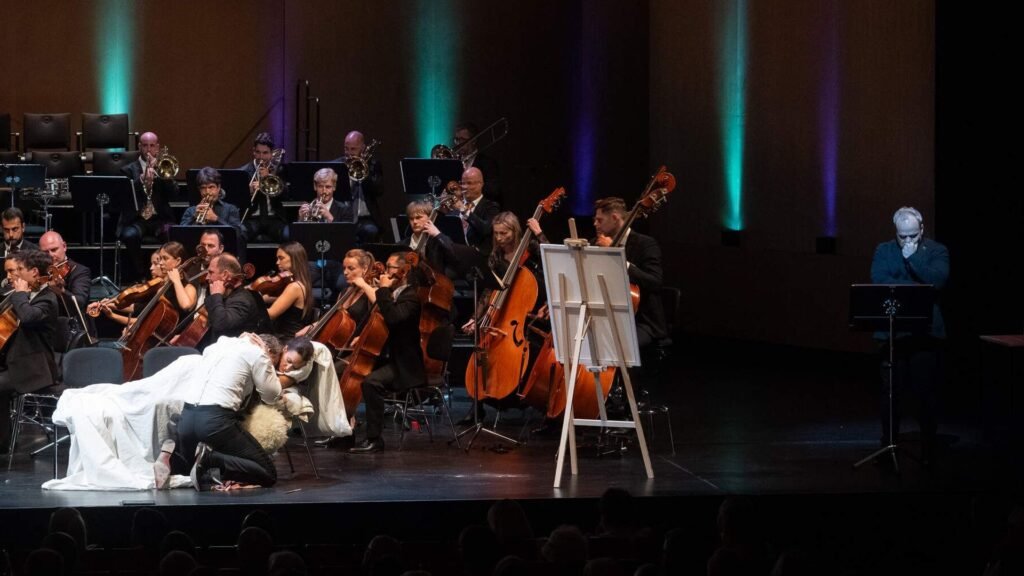
There was barely time to prepare or warm up, and certainly no rehearsal for what was about to happen. Inevitably, not everything could be perfect from the first notes. At times, particularly at the beginning, Owens’s voice lacked some of the projection one might normally expect from Rodolfo in a hall of this size. But the circumstances were extraordinary: he had stepped almost directly from the audience into the performance and was singing from the far side of the stage rather than from the centre.
It did not take long, however, for him to prove what a fine tenor he is. By the end of Act I, as Mimì and Rodolfo disappeared together and Puccini brought their first encounter to its glowing conclusion, Owens had already won the audience over, receiving a tremendous ovation at the bows. From there, his performance seemed only to grow. The more he sang, the more power and presence the voice acquired, perhaps as he became physically warmer and increasingly confident in this completely unexpected situation. By the final act, he was giving everything, vocally and emotionally, and there were moments of such intensity that they gave me goosebumps. What had begun as an astonishing last-minute rescue had become a genuinely moving performance in its own right.
Andrew Owens saved the night.
The solution was inevitably unusual. Bernheim remained onstage, continuing to embody Rodolfo, while Owens supplied his voice from the side. During the intimate duets, this occasionally created a strange separation between what we saw and what we heard, with Mimì at the centre of the action while Rodolfo’s voice reached her from elsewhere onstage. But under the circumstances, such imperfections seemed almost irrelevant.
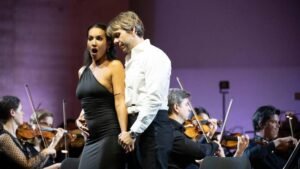
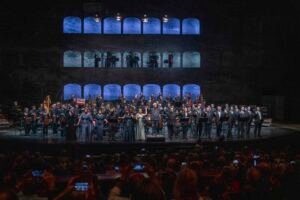
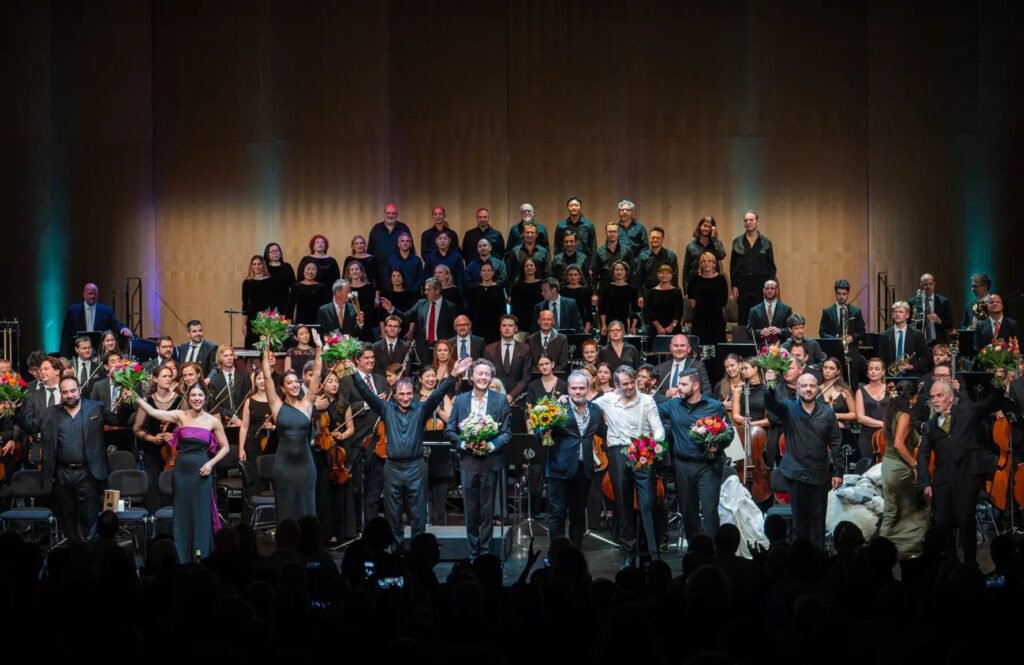
This was, after all, a concert performance rather than a fully staged La bohème. The Gstaad Festival Orchestra occupied the stage, while the singers nevertheless acted their roles, using a few props and enough theatrical interaction to bring Puccini’s world vividly to life. The remarkable thing was not that the improvised solution was theatrically perfect. It was that the performance was continuing at all—and at such a high musical level.
If Owens was the unexpected hero of the evening, he was surrounded by an exceptional cast. I had never heard Carolina López Moreno live before, although everything I had heard about her made me particularly curious to hear her for myself. Vocally, she was a revelation. Her upper register was radiant and secure, complemented by a lower register of impressive warmth and presence. Her breath control allowed Puccini’s long lines to unfold with remarkable ease, while the richness and variety of her vocal colours made an immediate impression.
Her interpretation of Mimì, however, left me with more complicated feelings. López Moreno possesses a naturally intense and powerful instrument, and I occasionally longed for greater fragility and restraint. I tend to imagine Mimì as shyer and more delicate, with an almost crystalline vulnerability that makes her fate increasingly heartbreaking. Dramatically, López Moreno offered a more sensual and self-assured woman, at times bringing her surprisingly close in temperament to Musetta. It was an interesting interpretation, but personally I missed some of the reserve that might have created a stronger contrast between the two women and allowed me to become more emotionally attached to Mimì as the tragedy unfolded.
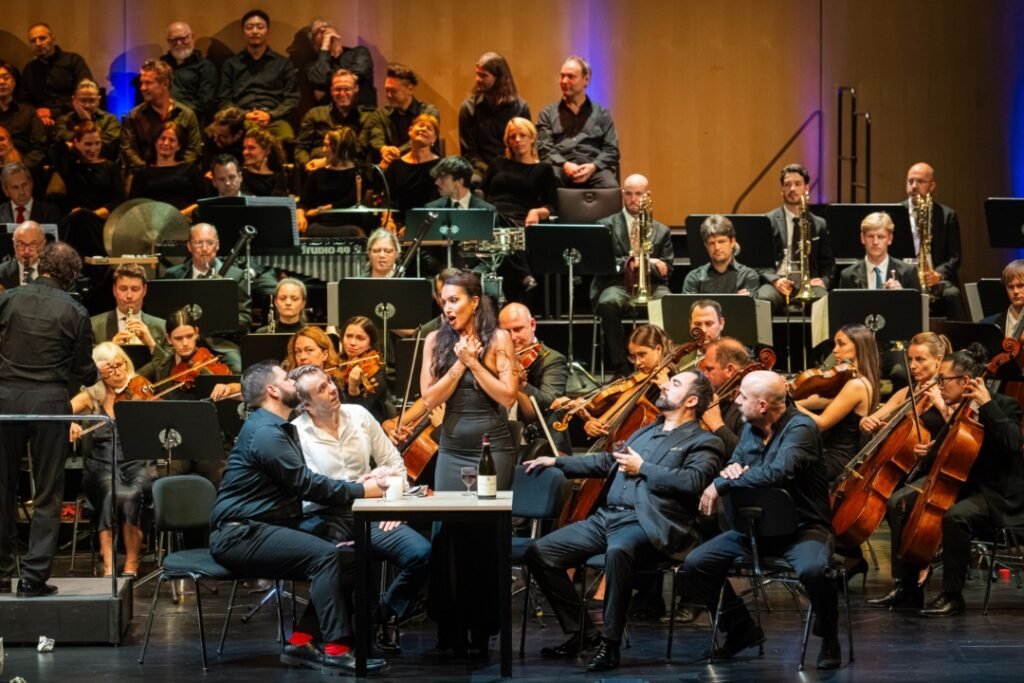
None of this diminished my admiration for López Moreno as a singer. Quite the opposite. She is one of those voices you discover one evening and immediately want to hear again, and I left Baden-Baden very curious to follow where her career takes her next.
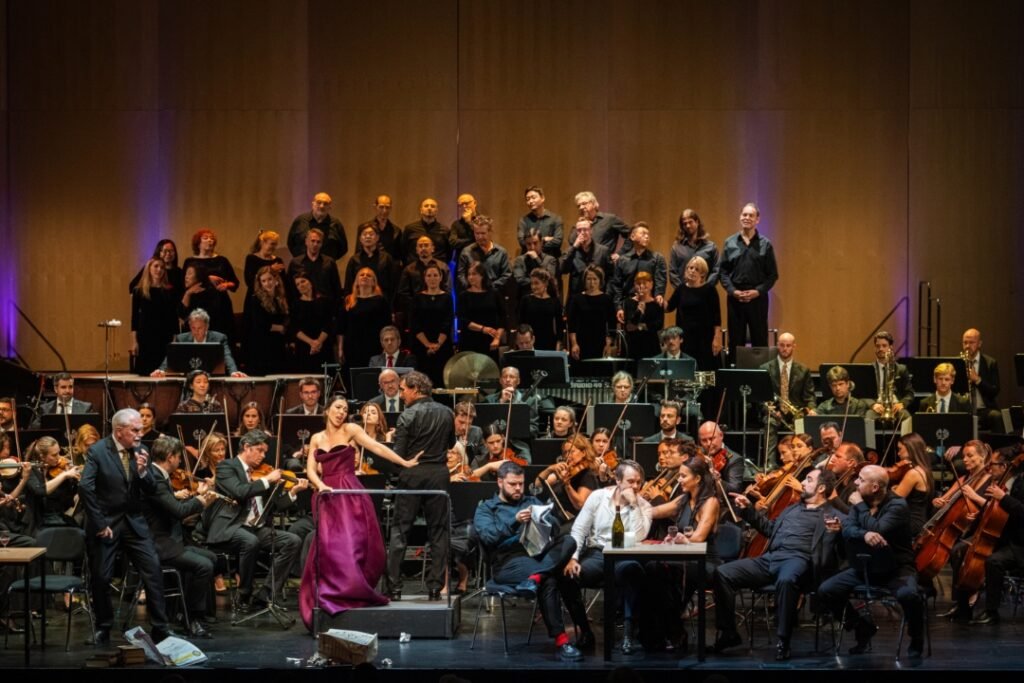
As Musetta, Sandra Hamaoui seemed completely at home. Charming, confident and wonderfully playful, she brought tremendous personality to the role without reducing Musetta to mere flamboyance. There was seductive energy and humour, but also genuine warmth, and as the evening progressed she allowed the more tender side of the character to emerge naturally. By the final act, she was deeply moving. I was particularly touched by how fully Hamaoui seemed to inhabit the role. By the final moments, there were tears in her eyes, and that emotion appeared to stay with her even during the curtain call.
The other three Bohémiens were equally important to the success of the evening. Lodovico Filippo Ravizza as Marcello, Biagio Pizzuti as Schaunard and Gianluca Buratto as Colline each brought his own colour and depth, but what impressed me most was their complicity. They genuinely felt like friends. Their humour and physical playfulness created that essential warmth at the heart of La bohème: the feeling that poverty, cold and uncertainty can somehow remain bearable when shared with the right people. Roberto Abbondanza, as Benoît and Alcindoro, completed this world with excellent comic instinct.
Holding everything together was Marco Armiliato. Conducting the Gstaad Festival Orchestra onstage, he shaped Puccini’s score with warmth, flexibility and an instinctive sense of its dramatic pulse. The orchestra brought colour and delicacy to the lyrical passages and tremendous energy to the bustling ensemble scenes, while never overwhelming the singers. The Chor der Bühnen Bern added further vitality, particularly to the crowded world of Act II, while the semi-staging by Fabio Rickenmann gave the singers enough freedom and theatrical detail for the evening to feel like far more than a conventional concert performance.
Yet perhaps the greatest achievement was the way everyone adapted when the unexpected happened. Armiliato suddenly had another Rodolfo. López Moreno had another voice answering her. The orchestra had to respond immediately. Bernheim continued acting, Owens sang from the side, and the rest of the cast carried on around them. Nobody could have made it work alone.
What emerged was a remarkable demonstration of teamwork: artists working together for the music, for Puccini, for one another and, ultimately, for the audience. It made me admire not only their talent but also the generosity and professionalism required when a carefully prepared performance suddenly has to be reinvented in real time.
Opera asks extraordinary things of the people who create it. We travel long distances for particular singers, conductors and performances, often arriving with expectations carefully constructed long before the first note is played. But behind those expectations are human beings, and live performance can never guarantee that everything will unfold according to plan.
On this evening, it certainly did not.
I had travelled to Baden-Baden for what promised to be a dream cast. And it was—just not in the way any of us had imagined. That evening, the dream cast somehow extended beyond the stage and into the audience. From there emerged Andrew Owens, an unexpected Rodolfo who joined an exceptional group of artists in turning what could have ended the performance into its most unforgettable chapter.
Perhaps that is part of what makes live opera so precious. Perfection can be rehearsed. The unexpected cannot. What happened in Baden-Baden required something else: talent, courage, generosity, trust and an extraordinary sense of teamwork.
For that, one could only be grateful.
Cast & Creatives
Conductor — Marco Armiliato
Staging — Fabio Rickenmann
Orchestra — Gstaad Festival Orchestra
Chorus — Chor der Bühnen Bern
–
Mimì — Carolina López Moreno
Rodolfo — Benjamin Bernheim
Rodolfo (substitute singer) — Andrew Owens
Musetta — Sandra Hamaoui
Marcello — Lodovico Filippo Ravizza
Schaunard — Biagio Pizzuti
Colline — Gianluca Buratto
Benoît / Alcindoro — Roberto Abbondanza
About the Author