SIEGFRIED | Bayreuther Festspiele
La Nature est un temple où des vivants piliers
Laissent parfois sortir de confuses paroles ;
L’homme y passe à travers des forêts de symboles
Qui l’observent avec des regards familiers.
Comme de longs échos qui de loin se confondent
Dans une ténébreuse et profonde unité,
Vaste comme la nuit et comme la clarté,
Les parfums, les couleurs et les sons de répondent.
(Baudelaire, “Correspondances”)
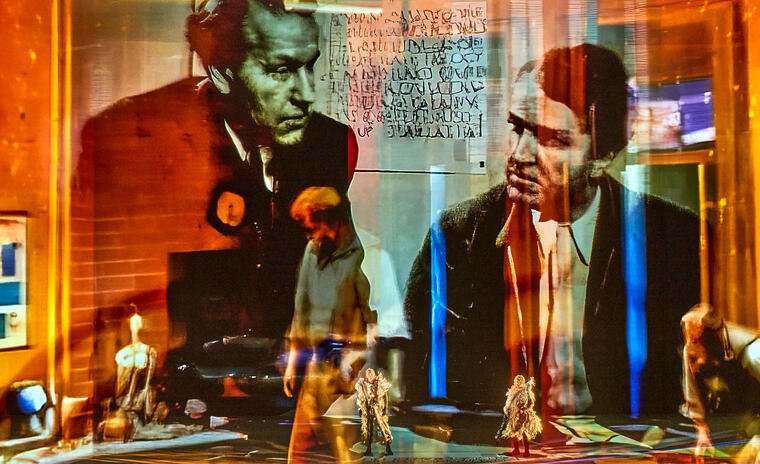
As Alain Duault would say, one need only replace “Nature” with “Ring”: everything is there. From the depths of the forest (of projected images, in the case of the 150th anniversary Ring at the Bayreuther Festspiele 2026) where Siegfried begins, to the summit of the rock (again represented through images generated by Artificial Intelligence under the much‑criticised supervision of Marcus Lobbes, with Nils Corte responsible for the design, Andri Hardmeier for the dramaturgy, Roman Senkl for digital support, and Phil Hagen Jungschlaeder and Nils Corte for the creative coding) where the work concludes; from the darkness of Mime’s cave to the powerful light that floods the final scene; from ignorance to knowledge: this broadly ascensional dynamic of Siegfried is replayed within each act itself.
More than Walküre, and above all in a more rigorous and systematic fashion across all three acts, Siegfried, whose composition began in early September 1856 in Zürich, is an opera of apprenticeship, in which all the protagonists are drawn into a kind of “pedagogy”. Thus, in Act I, Siegfried forces Mime to reveal the name of his mother, granting him a first access to the shattered sword (Nothung) in Scene 1; then Mime is in turn instructed by Wotan/Wanderer (Scene 2), and finally by Siegfried himself, and in the very domain where he is supposed to be master: the art of forging a new Nothung. The drawback of the approach adopted at Bayreuth is that, owing to a dramaturgy ultimately rather muted, this message is conveyed only through a straightforward understanding of the narrative text. Without it, it becomes quite impossible to grasp this crucial detail for understanding Siegfried’s role within the Tetralogy, thereby weakening the dramatic force of what follows or precedes it.
On the vocal front, where only male voices are required, the consistency of Wagner’s concern for vocal differentiation in each scene of Siegfried is striking. In what was heard at Bayreuth this year, this was respected: despite (or perhaps thanks to!) the difficulty of physically recognising the artists, all dressed in very similar dark‑coloured costumes (anthracite grey, black, a little white here and there), only their voices served as markers enabling us to understand “who was who” and “who was doing what”. Given the scant theatricality available to the soloists, some reduced to an almost immobile stance, others to very rudimentary movements (raising an arm, turning around themselves or around others, entering and exiting without any particular flourish, …), all the psychological shaping of the characters rested on their voices and on the orchestra, a kind of narrative‑scenario in which each vocal intervention was not mere décor but a living element. It was almost a musical canvas, where each contribution helped to draw and give life to the story being heard.
Siegfried was originally the central figure of the Ring myth. Wotan and Brünnhilde have partly dethroned him. Nevertheless, he remains omnipresent in the eponymous drama, where we see him successfully ascend each stage of his development. Klaus Florian Vogt, tasked with bringing to life a character he has already portrayed on several occasions since his role debut in 2023 in Zürich, possesses both the energy and the purity of intention to embody the title role convincingly. The longest tenor role in the Ring demands extreme endurance, which he supplies without difficulty, despite also singing Loge in Rheingold and Siegmund in Walküre: the metallic projection is tireless, cutting through the orchestra with ease even in its most saturated moments: the attacks are clean, the middle register is never covered and the required solar, youthful colouring is present throughout the entire performance. The most moving moment remains Act III, Scene 3 (Selige Öde auf sonniger Höh’!), before Brünnhilde’s awakening: the flames having vanished, in the setting of Walküre’s third act, the German tenor delivers singing of immense beauty and genuine sincerity during Siegfried’s awestruck discovery of Brünnhilde and his first experience of fear.
Gerhard Siegel’s Mime is endowed with incisive articulation, with consonants sculpted and biting, almost percussive. Sudden changes of dynamics and cunning intelligence are delivered with brilliance, demonstrating how perfectly this Spieltenor serves as Siegfried’s vocal counterpoint. Constant precision, an acidulated timbre, freely nasalised, ingenuity without nobility, yet never caricatured.
Michael Volle, a Heldenbariton par excellence, possesses the majestic gravity and natural authority required to bring to life a Wanderer of the highest calibre. We were already impressed by his presence and his vocal and dramatic stature in Rheingold and Walküre. Here, these impressions are reinforced, thanks to the shadowy, decaying dimension this “Traveller” requires. His emission is broad, dark yet agile, and each phrase carries, in addition to true melancholy, a declining sovereignty. In matters of legato, his singing is a veritable masterclass for young singers: the breath is continuous, despite the declamation, which is exemplary. A tragic lucidity, almost heartbreaking yet always dignified, permeates his interpretation.
Jochen Schmeckenbecher takes care to bring to Alberich a markedly dark, dense, evenrugged quality, imbued with immense violence, revealing a thirst for revenge that thickens the character’s profile, distancing him from the caricature or stereotype of the somewhat ridiculous Nibelung. The expressive force he deploys, whether through singing or articulation, is commensurate with the character’s fury, and this without respite, ever since Das Rheingold.
As for Peter Rose – entrusted with the role of Fafner, the fierce opponent of the Gods, calculating, Machiavellian, the “no‑court”, to put it simply – one almost regrets that so much talent is directed towards a character in which his capacities are under‑used. Nevertheless, the emission remains broad, the vibrato controlled, the timbre less cavernous than perfectly intelligible. One struggles to believe in the dragon (owing rather to the staging choices), but the fear he is meant to inspire is indeed conveyed by this voice upon which time seems to have no hold.
Like Wotan, Erda has a voice that points more towards a bygone world, symbolic of a loss of power both foretold and underway. Christa Mayer possesses a dark, enveloping timbre, but not quite telluric enough to our ears to embody the voice of the memory of a world destined to disappear.
After nearly four hours of opera during which she has been absent from the stage, Brünnhilde appears in the third act. A late entrance, certainly, but one in which she must emerge with freshness and intact power. The vocal colour must be capable of suggesting both the fallen divinity and the nascent woman, progressively shifting from the impersonal, hieratic timbre of the Walküre to a vulnerable, human warmth. A technical and interpretative challenge that Camilla Nylund meets with distinction, her evolution unfolding before an audience enchanted by such beauty.
Among the 91 leitmotifs present in the Ring, which sound 2,381 times across the Tetralogy, 650 are heard in Siegfried. These are recognised thanks to the meticulous craftsmanship of the conductor and the orchestra. The day on which the opera is the most “soloistic”, even the most “chamber‑like”, also demands symphonic detonations that Christian Thielemann delivers with masterly command. He ensures this polarity without making it aggressive, marks the difference (stemming directly from the compositional genesis of Siegfried, where Act II was written before the 12‑year interruption Wagner imposed upon himself to compose Tristan und Isolde and Die Meistersinger von Nürnberg) between Rheingold and Walküre, while maintaining continuity. The effect of surprise is therefore often accompanied by the soothing sense of being within a sequence of events unfolding with coherence and clarity.
******************************
Siegfried (WWV 86 C)
Oper von Richard Wagner (1813-1883)
Uraufführung : 16. August 1876 im Bayreuther Festspielhaus
Musikalische Leitung・Christian Thielemann | Kurator・Marcus Lobbes | Künstlerisch-technische Konzeption・Marcus Lobbes und Nils Corte | Dramaturgie・Andri Hardmeier | Digital- und KI-Storytelling・Roman Senkl | Creative Code and Visual Art・Nils Corte und Phil Hagen Jungschlaeger | Bühne・Wolf Gutjahr | Kostüm・Pia Maria Mackert
Siegfried・Klaus Florian Vogt | Mime・Gerhard Siegel | Der Wanderer・Michael Volle | Alberich・Jochen Schmeckenbecher | Fafner・Peter Rose | Erda・Christa Mayer | Brünnhilde・Camilla Nylund | Waldvogel・Victoria Randem・Cover photo credits: ©Bayreuther Festspiele
(For further informations) Link to the Bayreuther Festspiele: Siegfried
About the Author